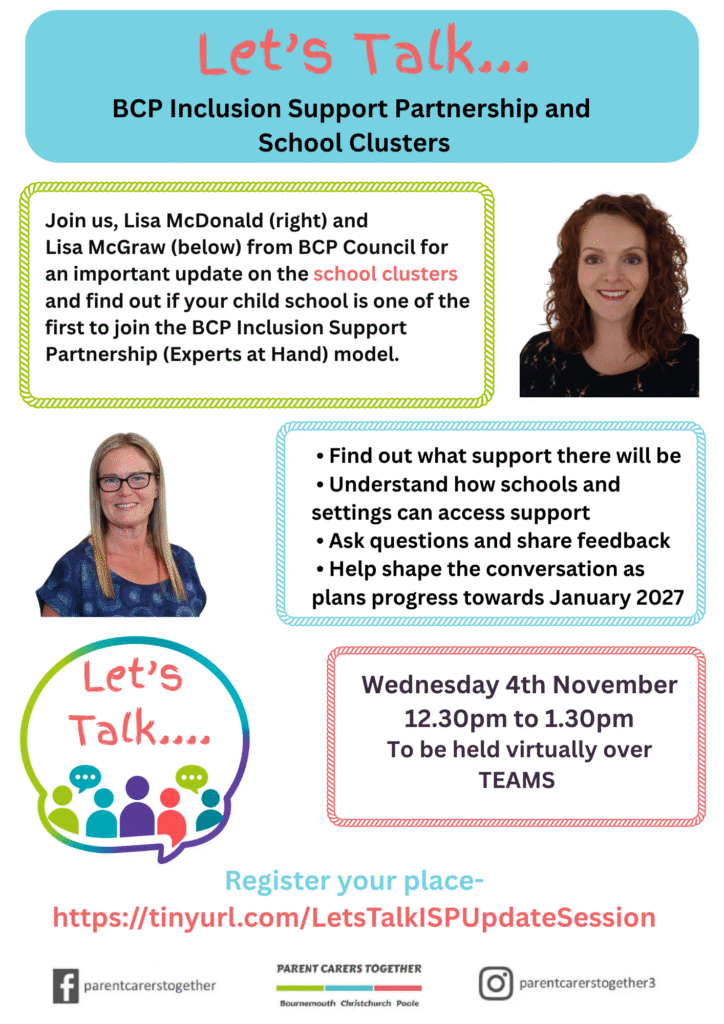
Register Now For Our Latest Let’s Talk…. Session
Let’s Talk…. BCP Inclusion Support Partnership and School Clusters update
Parent Carers Together will shortly be holding our second session of our Let’s Talk…. Series. As well as welcoming Lisa McGraw, Primary Advisor for the Education Effectiveness Team at BCP Council, Lisa Macdonald, BCP’s SEND and Inclusion Consultant will be joining us again to provide an update on the BCP Inclusion Support Partnership (Experts at Hand) and to explain more about the support that will be available and how schools and settings will access it. There will an update on the school clusters set to join the BCP Inclusion Support Partnership (ISP) model in January 2027.
Parents and carers are invited to join us, get the latest updates and ask any questions you may have.
You can register your place by scanning the QR code or clicking on the blue button below. Joining instructions will be sent out via email so please ensure you provide a valid email address.
*PLEASE NOTE- the presentation by the Lisa’s will be recorded for those unable to attend the event which will later be available on this webpage for people to access. Once the presentation has ended, the recording will stop ready for the parent Q & A part of the session. Parents can keep their camera and microphone switched off if they wish*
Come find out if you child’s school will be one of the first to join the model and what it will mean for you and your child.
News & Updates
Past Let’s Talk…. Events
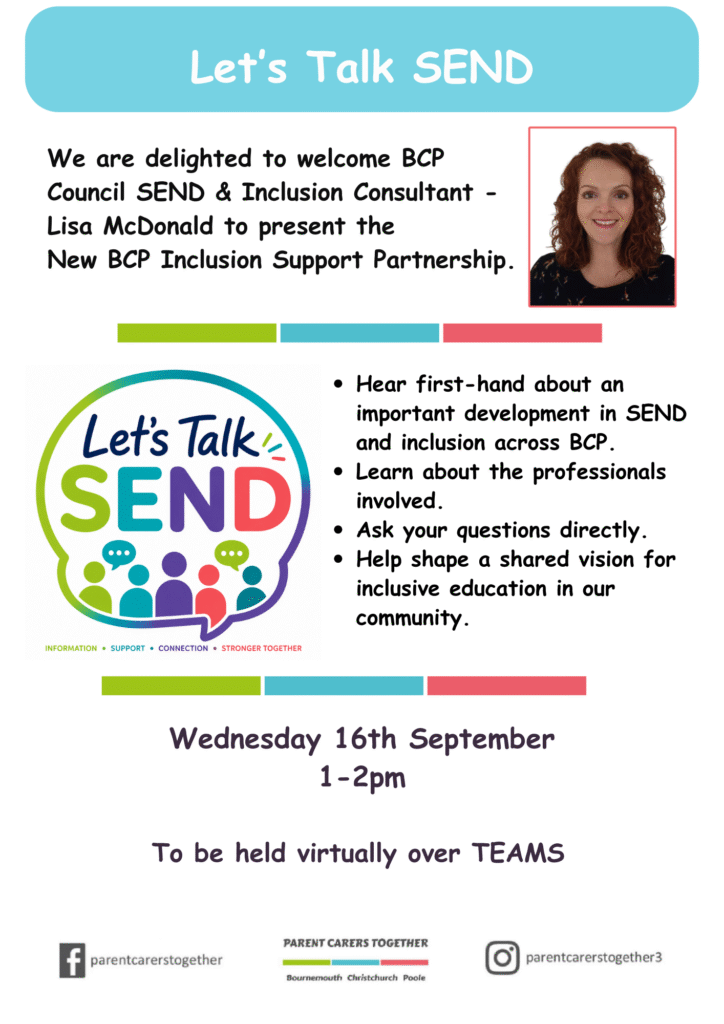
Let’s Talk…. SEND
On 16th September, Parent Carers Together (PCT) hosted the first session in our Let’s Talk series, focusing on two important developments for children and young people with SEND across Bournemouth, Christchurch and Poole: the Graduated Approach to Inclusion (GAtI) and the new BCP Inclusion Support Partnership, known nationally as Experts at Hand.
We were delighted to welcome Lisa McDonald, SEND & Inclusion Consultant, who guided families through the new approach, explained how the different elements fit together, and answered questions from parents and carers. Interest in the session was incredible, with 43 parent carers registering to attend.
What is the Graduated Approach to Inclusion?
The Graduated Approach to Inclusion (GAtI) is BCP’s framework for supporting children and young people with additional needs. Its aim is to ensure that every child and young person’s experience of education is inclusive, responsive and focused on helping them thrive within their local setting.
The framework is built around three levels of support:
*Universal SEND
*Support Targeted SEND Support
*Specialist SEND Support-championing inclusion for every child and young person.
The Graduated Approach provides guidance for schools and settings on identifying needs early, understanding barriers to learning and participation, and putting appropriate support in place. It promotes inclusive practice and helps schools ensure that children receive the right support at the right time.
As part of the session, Lisa introduced families to the new BCP Graduated Approach to Inclusion website, which provides resources, guidance and practical tools to support schools and settings in delivering inclusive practice.
What is the BCP Inclusion Support Partnership?
While GAtI provides the framework, the BCP Inclusion Support Partnership (Experts at Hand) is the model that helps schools and settings put that framework into practice.
The Inclusion Support Partnership forms part of the wider SEND Reform programme and brings together professionals from education, health and care services to provide advice, guidance and specialist expertise. The aim is to help schools access support earlier and strengthen their ability to meet the needs of children and young people within their own settings.
Rather than focusing solely on individual children, the model is designed to build the confidence, knowledge and skills of school staff so that more children can benefit from improved inclusive practice. Most support will be offered through consultation, coaching, training, small-group work and whole-school approaches.
What Does This Mean for Families?
One of the key messages from the session was that the Inclusion Support Partnership does not replace any existing statutory SEND processes. Education, Health and Care Needs Assessments (EHCNAs), Education, Health and Care Plans (EHCPs), SEND Support and schools’ legal duties all remain exactly the same. The model is intended to provide schools with an additional route to access advice and support when it is needed.
Every school and post-16 provider will have access to a named Inclusion Lead, while every early years setting will be linked to an Area SENCo.
For example: a school or setting identifies a cohort of children experiencing similar ongoing barriers to learning, participation or wellbeing, they will work with families to better understand the child’s strengths, needs and challenges. The school can then submit a Request for Help to access additional advice and support.
A Request for Help is not a new referral pathway. It is simply a way for schools and settings to access additional expertise and explore possible solutions.
Support may involve advice from:
*Experienced school leaders
*Inclusion Leads
*Educational Psychologists
*Occupational Therapists
*Speech and Language Therapists
*Other specialist practitioners
By bringing together professionals with different expertise, schools can access practical advice and support to help meet children’s needs earlier and more effectively.
Questions Raised by Families
The discussion that followed highlighted many of the issues that matter most to families. Parents and carers asked thoughtful questions about how the new model will work in practice, including:
*Individual Support Plans (ISPs) and how children’s individual needs and reasonable adjustments will be reflected.
*How Occupational Therapy and other specialist services will contribute through outreach and consultation.
*Which schools and settings will be included in the programme.
*The need for improved SEND and neurodiversity training across schools.
* Understanding neurodivergence and masking.
*How reasonable adjustments will be identified, agreed and implemented.
*What happens when parents and schools disagree about support.
*How the model will work within academy schools.
* How the programme will ensure changes are seen in classrooms and experienced by children and families.
These are important questions, and PCT will continue to ensure that family experiences and concerns are represented as the programme develops.
Frequently Asked Questions
Families have told us that they want clear, accessible information about what this new approach means for them. In response, BCP Council, Parent Carers Together and Parent Carer Foundation worked together to develop a Frequently Asked Questions document covering:
*The purpose of the Inclusion Support Partnership.
* How the Request for Help process works.
*How families will be involved.
* Access to specialist support.
*Pilot arrangements and implementation timescales.
* How feedback from families, children and young people will be gathered and used.
What’s Next?
The Inclusion Support Partnership will be introduced in phases, with pilot clusters beginning in January 2027. Feedback from schools, settings, children, young people and families will help shape future developments before the model is rolled out more widely across BCP during 2027.
Parent Carers Together is represented on the Inclusion Support Partnership Implementation Group and will continue to ensure that the views, experiences and questions of families across Bournemouth, Christchurch and Poole remain at the heart of the programme.
We would like to thank everyone who attended the session, contributed to the discussion and shared their perspectives. Your feedback plays an important role in helping to shape services and support for children and young people with SEND.
Watch the Session and Find Out More…
*Presentation with voiceover by Lisa McDonald
*BCP Graduated Approach to Inclusion website
Coming Up
We’re pleased to share that Lisa McDonald has agreed to join us again on 4th November 2026 to provide an update on the progress of the BCP Inclusion Support Partnership. More details will be shared soon.
In the meantime, we encourage families to explore the resources, watch the presentation and continue sharing their experiences and questions with us. By working together, we can help ensure that SEND reforms deliver meaningful improvements for children, young people and families across BCP.